Proof
A month of work, down to three days.
An international B2B training provider ships the same course to trainees in about 30 languages. This is what happened when the manual half of that came out, and what the people doing it are working on instead.
- 30 minutes
- for a native speaker to sign off on a piece of training content in their own language. Producing that version from scratch took most of a day.
- 3 days
- to put one round of content into about 30 languages, start to finish. Across everyone involved it used to come to about a month of work.
- ~87%
- of the manual hours are gone. They went back into the training itself, where a person in the room is the whole point.
The work
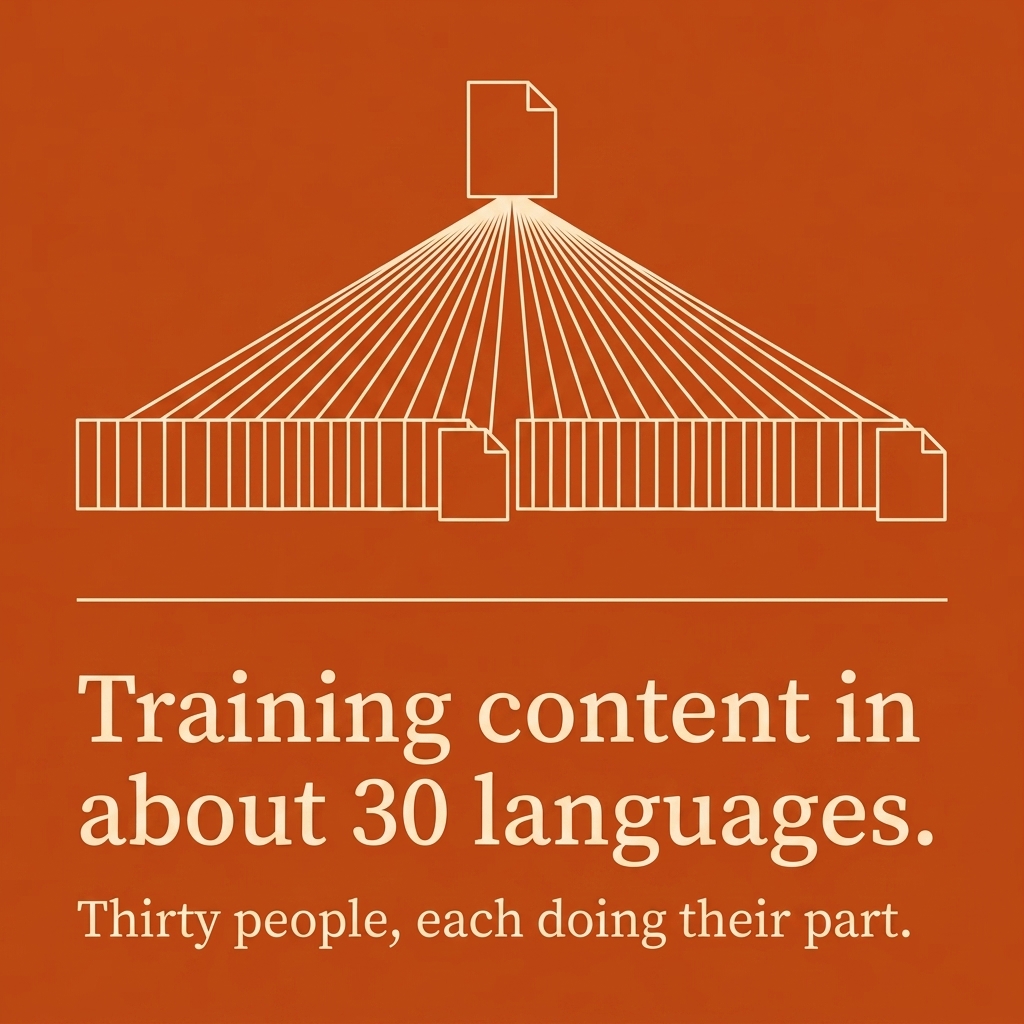
The same course, thirty times over.
Every round of training content had to be translated, checked by someone who speaks the language natively, given a recorded voiceover, and turned into a finished video. Then it had to happen again for the next language, and the next, about thirty times.
Thirty people each doing their part. None of it was hard in isolation. Added up, one round came to roughly a month of work, and it came round again the following week.
On top of all that sat the coordination. Someone had to know where every piece was, who was holding it, what was overdue, and who needed a nudge this week. That is the work nobody puts on a plan, and it does not show up as a task on anyone's list.
The hours
Where the month actually went.
Five stages, measured per round across all languages. The dark bars are what is left.
About 170 hours per round became about 22. Every figure here is our own conservative estimate of our own work.
What changed
The work didn't get less valuable. It moved.
A translator's judgement is what decides whether content works in their market, and that is still true. What changed is where it gets spent. They are applying it to a version that already exists instead of producing each one from scratch, and that takes about half an hour instead of most of a day.
The same goes for the parts around it. Recording a voiceover properly needs a quiet room, the right equipment, the software and someone who can use all three, thirty times over. It is real craft, and the technology got good enough to cover it for material like this.
The coordination went the same way. The whole process is tracked end to end now: every piece has a state, the right person is told when it is their turn, and reminders go out on their own. Nobody chases anybody by email, and nobody has to hold the current status of thirty languages in their head.
Nothing here replaced a judgement call. Every language is still signed off by a person before it ships.
Where the hours went
Back into the room.
Freed hours only count if you can say where they went. These went into the training itself. The same people now spend more of their time coaching, which is the most valuable part of the whole thing and the part that shouldn't be automated at all.
Worth saying plainly: one role did disappear in all this, and it was the video editor's. That was the person writing this. It was the right call, and the same team now puts out far more than it ever could by hand.
What's eating your team's week?
A free 30-minute call: you tell us where the hours go, we tell you straight whether automation makes sense.
Book a free intro call